The Big Problem
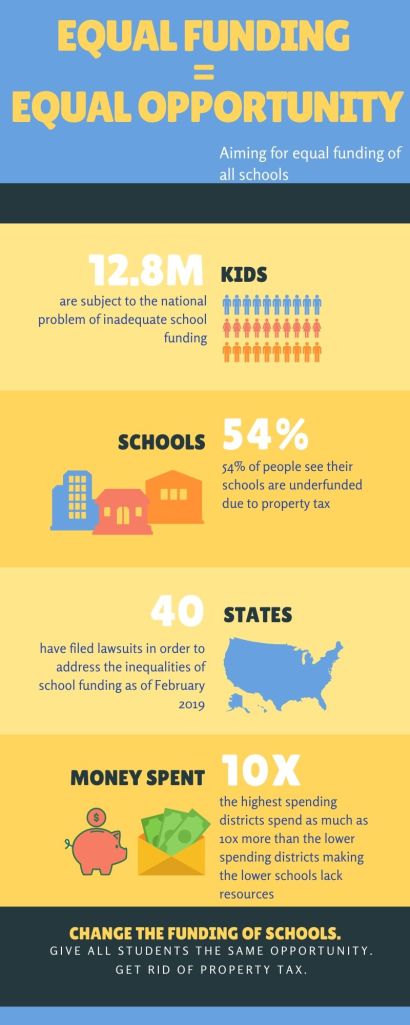
School funding is a heavily talked about subject today, mainly because it has become a huge problem. This is mainly due to schools receiving their funding from property tax. The issue with this is that the areas with more expensive houses are giving more of their money away to the school districts while the areas with less expensive houses are paying less due to lower property tax. This creates a huge gap in the money each district must spend because it relies mainly on the expenses of the people in each area. Schools with less money to spend become insufficient for students in terms of resources available to the students which creates a gap between the students attending schools in the lower-spending districts and the students attending schools in the higher-spending districts.
This gap not only affects students, but also affects teachers and low-income families. Families cannot easily change the amount of income they are receiving which correlates to the location families live. Districts that do not have enough funds may not have enough money to hire certified teachers as well. This means that on top of students not have an adequate supply of resources some schools are not being instructed by adequate or certified teachers. If they do have certified teachers, many may choose to not stay at the school because they can likely go to a different school and get paid more money which leaves the schools with teachers who may not care about their jobs, or who may not be well educated on the subject material they are teaching.
In my time from going to elementary through high school to observing schools, the difference in schools I’ve been in have differed. I was never aware of how much property tax can play a role in schools until I learned about it through my education classes and was able to see it first hand in some of the schools,I have been able to observe. For example, in fall 2019, I observed a middle school that was overpopulated. The school contained students from 6th-8th grade. The classroom I was in was only half a classroom and had up to 32 students. There was a wall divider in between the classroom and the classroom next door and when opened, it was the size of a full classroom. Since they didn’t have enough space for all the students, they had to keep the wall closed to ensure that they had a decent teacher to student ratio, and it wasn’t too much for the teacher to handle. We had classrooms like this in my elementary school, but the classrooms with the wall closed were normal sized classrooms, not half a classroom. Due to the property tax in the area I observed this middle school not being nearly the same as the property tax in my hometown, the school was overpopulated. There is also only one middle school in this area because it is a small-town, which is much different than my hometown as well. There were about 2 or 3 middle schools within 10 minutes from each other.
A Misconception
Some people think that money doesn’t make a difference in a student’s experience at school. This is not true. School funding makes a huge difference. The more resources a school has, the more it can give to a student to aid with their learning. Not only this, but the more money a school has, the more they can pay their teachers. This means that schools can hire more teachers that are knowledgeable on their teaching subjects and are good with the content in their subject area. Also, with more money to pay their teachers, they can pay certified and quality teachers to stay at their school to adequately teach their students.
At a school I observed this past semester, they had many problems keeping qualified teachers in the school. I often heard about teachers leaving because they were not happy with the environment and pay of the school. I had first hand experience with a teacher that was a grad student, still studying teaching, that was hired as a temporary teacher because the teacher that was there left suddenly in the middle of the year. This teacher that took her place graduated from university as a nurse and got hired at a school with little to no experience being in the classroom. This was a bit alarming to me, because if she has some experience, but not much teaching in a school and got hired, this happens at many more schools as well.
Not only does students’ access to resources and qualified teachers matter but having these leads to higher student achievement. People should care about the equal funding of schools because it ultimately leads to the future our nation. If schools aren’t equally funded, we as a nation are not getting to seethe greatest potential of all students. The changing in school funding can ultimately lead to the closing of the achievement gap.
Steps

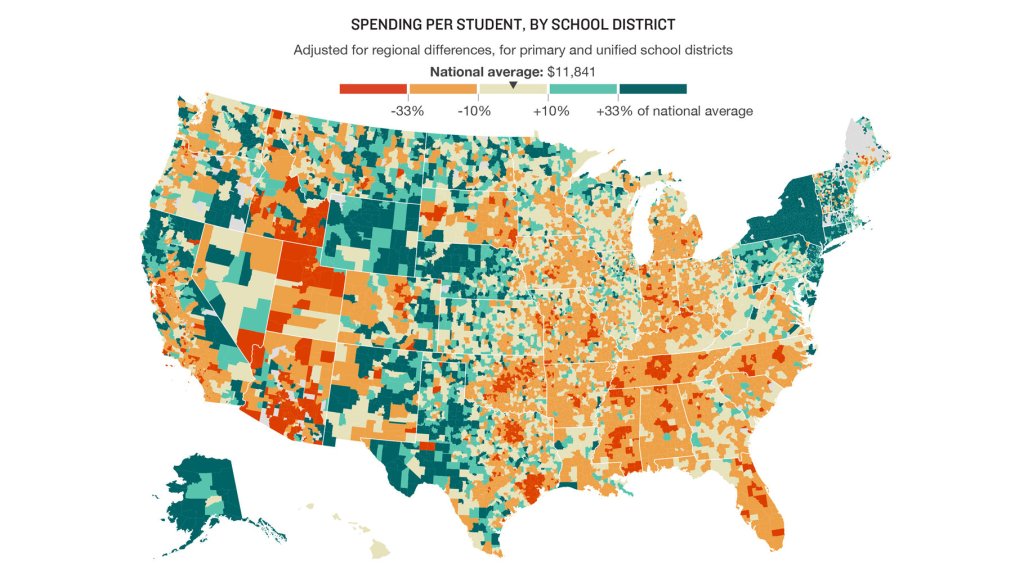
There have been steps slowly being taken by a few states. These steps strive to achieve the overall goal, the balancing of funds between districts. In an article from Forbes, it states that 12 states in 2015 were trying to balance their funding. Of these 12 states, only 5 provided adequate support to students to receive the resources they need (Forbes). Other ideas on howto solve this issue have been suggested by various sources.
Some of these ideas of change for states include investing in early childhood education, hire well-prepared teachers, organize schools to be productive, and redesign finances to focus on student needs. By investing in more early-childhood education programs, it can help close the achievement gap at an earlier age which will help it not exist at all. There also ideas for change at the federal government level. Some of these ideas include equalizing distribution of resources across all states, requiring that states receive federal funds to report on achievement progress and movement towards equitable access to resources (Forbes). By enacting these changes into the school districts’ funding, it will create a more equal environment to better enrich students’ learning.
After making strides to enact these changes, schools will be able to focus on other ways to enrich their school. This can include but is not limited to increasing teachers’ salaries, as well as instituting more professional development to help the teachers become better trained to efficiently teach students.
Taking these steps will lead to more equal funding of school districts and will lead to closing the achievement gap.
 Meghan's Blog